AskAwayHealth
Is That Bump Down There Dangerous? A GP Decodes 7 Types — From Ingrown Hair to Lichen Sclerosus
April 18, 2026

You found something. You pressed it twice, then opened Google at midnight — and now you’re somewhere between “probably nothing” and a spiral you can’t stop. I know exactly where that goes.

Before you spend another night on forums, I need you to read this: the bump you’ve found almost certainly has a name, and that name is almost certainly not the one you’re most afraid of.
Watch First: Is This Dangerous? Ingrown Hair, Cyst or Something Worse ‘Down There’?
Why Vulval Bumps Cause So Much Panic
The vulval area is one of the most under-discussed parts of the female body — and that silence creates an information vacuum. Most women have never been given a clear picture of what normal looks like down there, let alone a framework for understanding what different lumps and bumps actually mean. So when something unexpected appears, the mind immediately reaches for the worst.
Here is the clinical reality: eight different things can cause a bump in the vulval area. Seven of them are completely benign. One of them — only when accompanied by specific warning signs — needs prompt medical review. This post is your guide to telling the difference.
Type 1: Ingrown Hair
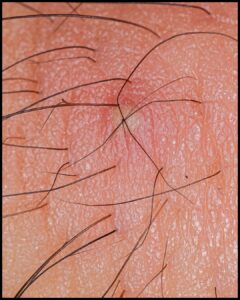
Ingrown hairs are the most common cause of vulval bumps in women who shave, wax, or epilate the pubic area. When a removed hair regrows, it can curl back into the skin rather than emerging outward. The body treats the trapped hair as a foreign object and mounts an inflammatory response — that reaction is the bump.
What it looks like: A small red or skin-coloured bump — sometimes with a dark spot in the centre where the hair is trapped. It may be tender to touch and looks a lot like a pimple.
The mistake most women make: Picking at it. Picking introduces bacteria and can turn a minor irritation into a proper abscess. Leave it alone.
Your action step:
- Warm compress twice a day — the warmth draws the hair closer to the surface
- If you can see the hair tip near the surface, a clean, sterilised needle to gently lift (not dig) is fine
- Give it 1–2 weeks; most ingrown hairs resolve completely without intervention
- If it is deep, infected, or growing rapidly — GP visit
Type 2: Fordyce Spots
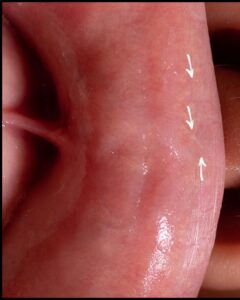
Fordyce spots are one of the most common reasons women present to me in a panic — convinced they have an STI — and leave twenty minutes later having been told it is normal skin anatomy that has always been there.
What they look like: Tiny, pale, yellowish or skin-coloured spots, usually appearing in clusters. They have no head like a pimple. They don’t itch, don’t hurt, and have no discharge.
What causes them: These are sebaceous glands (oil-producing glands) without a hair follicle attached. They are a completely normal anatomical feature — not a sign of infection, not sexually transmitted, not a disease of any kind.
Your action step: Nothing. No treatment is needed or recommended. This is simply how your skin is built.
Type 3: Bartholin’s Cyst
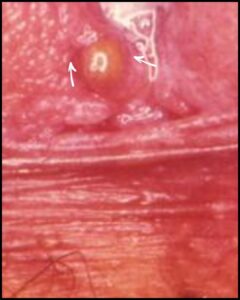
The Bartholin’s glands sit at the 4 o’clock and 8 o’clock positions at the entrance to the vagina. Their function is to produce lubrication. When the duct of one gland becomes blocked, fluid accumulates — forming a Bartholin’s cyst.
What it looks like: A smooth, round lump near the vaginal entrance — ranging from pea-sized to walnut-sized. A simple cyst is usually painless or mildly uncomfortable. When it becomes infected and turns into a Bartholin’s abscess, the pain becomes severe and the swelling significant.
Your action step:
- For a small, painless cyst: sitz baths 3–4 times a day in warm water
- For a painful, rapidly enlarging swelling, or if you have a fever: GP or urgent care same day
- I have a full, dedicated video on Bartholin’s cyst home treatment — linked in the description of the video above
Type 4: Molluscum Contagiosum
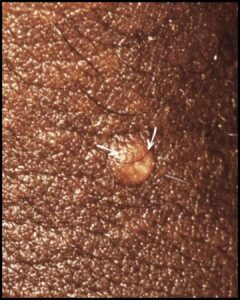
Molluscum contagiosum is caused by a poxvirus (molluscum contagiosum virus/MCV). In adults, in the genital area, it is most commonly transmitted through skin-to-skin sexual contact. This does not mean other STIs are present — it is a separate, very common and very manageable condition.
What it looks like: Multiple small, round, dome-shaped bumps — flesh-coloured or slightly pearlescent. The key diagnostic feature is a tiny dimple or depression in the centre of each bump. They appear in clusters, are not usually painful, and may occasionally be itchy.
Your action step:
- See your GP for diagnosis and a discussion of treatment options
- Options include cryotherapy (freezing), topical creams, or watchful waiting — lesions often resolve on their own within 6–18 months
- Do not try to pop or squeeze them; you will spread them further
Type 5: Genital Warts (HPV 6 & 11)
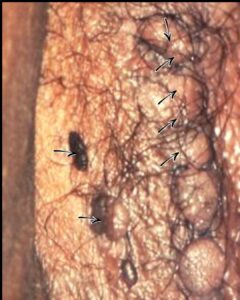
Genital warts are caused by the Human Papillomavirus (HPV) — specifically the low-risk strains HPV 6 and HPV 11. This is a critical distinction: these strains are different from the high-risk HPV strains (16 and 18) associated with cervical cancer. A diagnosis of genital warts does not mean you are at higher risk of cervical cancer from the same virus. Genital warts are the most common STI presentation I see in clinic.
What they look like: Soft, skin-coloured or slightly darker growths — flat, raised, or textured. Sometimes described as resembling small cauliflower florets. They may appear singly or in clusters. Usually painless, occasionally itchy.
Your action step:
- See your GP or sexual health clinic for diagnosis — do not self-treat
- Treatment options include podophyllotoxin cream, cryotherapy, or surgical removal
- Your partner should also be assessed
- If you have not had your HPV vaccine — please ask; it is available to adults up to age 45 in some UK settings
Type 6: Herpes Simplex
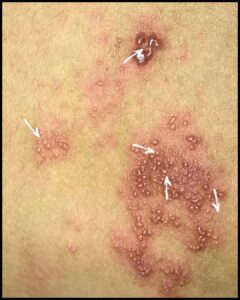
I want to spend a moment here — because herpes carries a stigma that is entirely disproportionate to what it actually is, medically. It does not define you. It does not preclude a full, healthy relationship. And it is far more common than most people realise.
Herpes simplex is caused by the herpes simplex virus (HSV) — either HSV-1 or HSV-2. Both types can affect the genital area. It is transmitted through skin-to-skin contact, including during periods when no visible lesion is present — this is called asymptomatic shedding.
What it looks like: A primary outbreak typically begins with tingling, burning, or itching before any spots appear. Then: small blisters or ulcers that can be painful, may weep, and crust over. Unlike most other bumps on this list, herpes lesions are typically painful — this is a key distinguishing feature.
Your action step:
- If you suspect a first outbreak: see your GP or sexual health clinic urgently — antiviral treatment (aciclovir) is most effective when started early in the outbreak
- Recurrent outbreaks are usually milder and shorter
- Long-term suppressive therapy is available for women with frequent recurrences — ask your GP
Type 7: Lichen Sclerosus Skin Changes
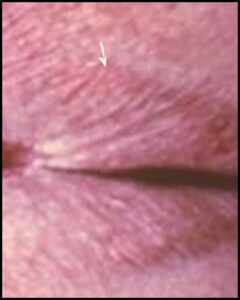
Lichen sclerosus is a chronic inflammatory skin condition that primarily affects the vulval area. It is included here because its changes — when untreated and progressed — can produce thickened, raised, or cracked (fissured) areas that feel unusual or lump-like, particularly at the vaginal entrance.
What it looks like: White patches, thinning or crinkled skin, small splits or breaks at the vaginal entrance. Intense itching — often worse at night — is the hallmark symptom. If you have been treating this as recurrent thrush without lasting resolution, lichen sclerosus needs to be on your radar.
Why this one matters beyond the bump: Untreated lichen sclerosus is associated with a small but real increased risk of vulval squamous cell carcinoma over time — estimated at 4–5% in long-term, untreated cases. Early treatment with potent topical corticosteroids significantly reduces this risk and controls symptoms effectively.
Your action step: See your GP — do not wait. I have a complete dedicated video on lichen sclerosus linked in the description of the video above.
UK Reference: NHS: Lichen Sclerosus — Symptoms, Treatment and Outlook: Is That Bump Down There Dangerous? A GP Decodes 7 Types — From Ingrown Hair to Lichen Sclerosus US Reference: Mayo Clinic: Lichen Sclerosus — Symptoms and Causes: Is That Bump Down There Dangerous? A GP Decodes 7 Types — From Ingrown Hair to Lichen SclerosusYour GP’s 5-Step Framework for Using This Guide
Don’t leave this page without a concrete action plan. Here is how to apply what you’ve just read:
| Step | What to Do |
| 1. Describe your bump | Is it painful or painless? Single or multiple? Does it have a dimple, a trapped hair, a blister, or none of these? |
| 2. Match it to the list | Work through Types 1–7. Most of the time — ingrown hair, Fordyce spots, or Bartholin’s cyst will be your answer |
| 3. Apply the right action step | Warm compress for ingrown hair. Sitz bath for Bartholin’s. GP visit for anything that matches the red flags below |
| 4. Set a timeline | Give a benign, self-resolving bump 2–4 weeks. If nothing improves — book the appointment. Don’t leave it open-ended |
| 5. Use the vocabulary | Tell your GP: “I have a lump in the vulval area. I’d like it examined. I’m particularly concerned about [specific feature].” That sentence gets you seen properly |
Red Flags — When to Seek Help
These are not panic triggers. They are diagnostic prompts. In the vast majority of cases, even with these features present, the outcome is benign. But the pathway to that reassurance goes through a doctor — not Google.
| Red Flag Feature | Why It Matters | Action |
| Growing rapidly — noticeably larger over days (not weeks) | Rapid growth signals infection, cyst rupture risk, or — rarely — malignancy | GP or urgent care same day |
| Hard and fixed — doesn’t move when you press around it | Solid masses or fixed lymph nodes require clinical examination | See GP within 1 week |
| Associated with unexplained bleeding — between periods, after sex, or post-menopause | Potential vulval pathology including pre-malignant change | See GP within 1 week — flag as urgent |
| Irregular surface or border | Irregular edges can indicate abnormal cell changes | See GP within 1 week |
| Any new lump in a post-menopausal woman | Index of suspicion is higher post-menopause — always warrants review | See GP within 1 week |
| Lump present for more than 4 weeks with no change or improvement | Requires clinical examination regardless of appearance | Book GP appointment |
| Swelling with fever and feeling unwell | Bartholin’s abscess or spreading skin infection (cellulitis) | Urgent care same day |
| Associated pelvic pain not otherwise explained | Internal pathology may be contributing | See GP within 1–2 weeks |
The Bottom Line
The vast majority of vulval bumps are benign, common, and either self-resolving or easily treated. The barrier is not the seriousness of the condition — it is the silence, the shame, and the midnight panic spiral that stops women from getting answers. You now have a clinical map. Use it. If something doesn’t fit the picture or matches any of the red flags above, make the appointment. Getting examined is always the right decision — and you now have exactly the language to ask for it confidently.
Which number on the list do you think you’re dealing with? Drop it in the comments on the video — just the number. You don’t have to say anything else. → Join the free AskAwayHealth community
Similar Topics
About The Author
Dr Sylvia Kama-Kieghe (FRCGP, FRSM, FRSPH) is a UK-based NHS General Practitioner with over 15 years’ experience in family medicine and women’s health. She is the founder of AskAwayHealth and works clinically in primary care, urgent care and digital health.
She is a honorary lecturer at the University of Sheffield Medical School and involved in teaching and supervising trainee doctors. Her clinical practice includes a strong focus on menopause, menstrual and fibroid-related problems, vulval and vaginal health, and preventive care for women across the life course.
Dr Sylvia is an RCGP (Royal College of General Practitioners) Digital Champion 2026 award finalist and has been shortlisted multiple times for the CAHN Black Healthcare Awards for her work in reducing health inequalities. She also collaborates with the Patient Information Forum (PIF) on projects tackling online health misinformation and improving the quality of patient information.
Through the AskAwayHealth YouTube channel and website, Dr Sylvia aims to provide clear, calm and clinically sound explanations that help women understand their symptoms, know which red flags to look for, and feel more confident when speaking to their own doctors.
Review Date
This post will be medically reviewed by April 2028

Want to know how your comment data is processed? Learn more





Leave a comment
Please fill in the field below to add a comment.